
Across Europe, the sales of battery electric cars (BEVS) are increasing, with more sold each week now than in the entire year of 2012.
They avoid the need for fossil fuels. Will hydrogen fuel cells be the real revolution of the future?
The International Energy Agency (IEA) claim there is a mismatch between the strengthened climate ambitions of the auto industry, and the availability of critical materials. Lithium and cobalt are two key components and are becoming the most valuable commodities on the planet. As finite materials, depleted when used. This poses the question; could hydrogen fuel cells demonstrate a more sustainable future for the car industry?
So how does a hydrogen fuel cell work?
- Contains a fuel tank that stores hydrogen in its gas form, since liquid hydrogen requires cryogenic temperatures (-253°C).
- It combines hydrogen and oxygen in a chemical reaction that generates electricity.
- It is used to power the vehicle, with water vapour as the only waste product.
- Since hydrogen is the most abundant element in the universe, hydrogen fuel cells are a completely renewable energy source. They have no polluting outputs, but hydrogen is present in nearly all molecules in living things.

Over 90% of hydrogen fuel produced currently comes from fossil fuels. Natural gas is reacted with high-temperature steam for synthesis gas. Carbon monoxide is reacted with water to produce additional hydrogen. This method is the cheapest, most efficient. It is a common way to obtain hydrogen, but the hydrogen generated only holds around 75% of the energy used to produce it. This means it costs more energy to obtain hydrogen than it will generate when reversed in the fuel cell. Carbon dioxide and carbon monoxide are two greenhouse gases. They are also waste products of this technique, consequently rendering natural gas reforming a highly inefficient and counterintuitive procedure.
Alternatively, electrolysis of water uses an electric current to split water into hydrogen and oxygen. If electricity is produced by renewable sources, solar or wind, the hydrogen is entirely renewable. This procedure seems faultless in theory, but it does not quite work in practice. With current technology, conventional electrolysis produces hydrogen at only 75% efficiency. We can investigate this efficiency further, noting the hydrogen requires storage in a high-pressure tank. A study by the European Federation for Transport and Environment, found storage of hydrogen at such high pressure requires 40% of the energy stored in the fuel itself. The most efficient hydrogen-fuel cells then convert the stored hydrogen into electricity. It powers the electric motor of the car with 60% efficiency. This motor is then 95% efficient. Only 25% of the initial energy produced at the power station is converted into the motion of your car.
The important comparison between electric vehicles and hydrogen fuel cells. Electricity is easier and more efficient to transport than hydrogen and uses existing infrastructure to do so. After transportation, it is significantly more efficient to Retrieve energy from batteries than to convert it in a fuel cell. Electricity travels through existing power lines with 95% efficiency. Charging a lithium battery is 90% efficient. Using the power from that battery in an electric motor is around 95% efficient. Approximately 73% of the initial energy produced at the power station is converted into the motion of your car. This is almost three times more efficient than the hydrogen fuel cell.
Comprehending that both the electric battery, and the hydrogen fuel cell are just methods to deliver electrical energy to an electrical motor. The battery stores this electricity directly and efficiently for use. The fuel cell requires a chain of processes, that each use up a part of the energy along the way. A hydrogen car will not prove environmentally sustainable until the energy required to produce and transport the hydrogen can be generated purely and much more efficiently through renewable techniques.
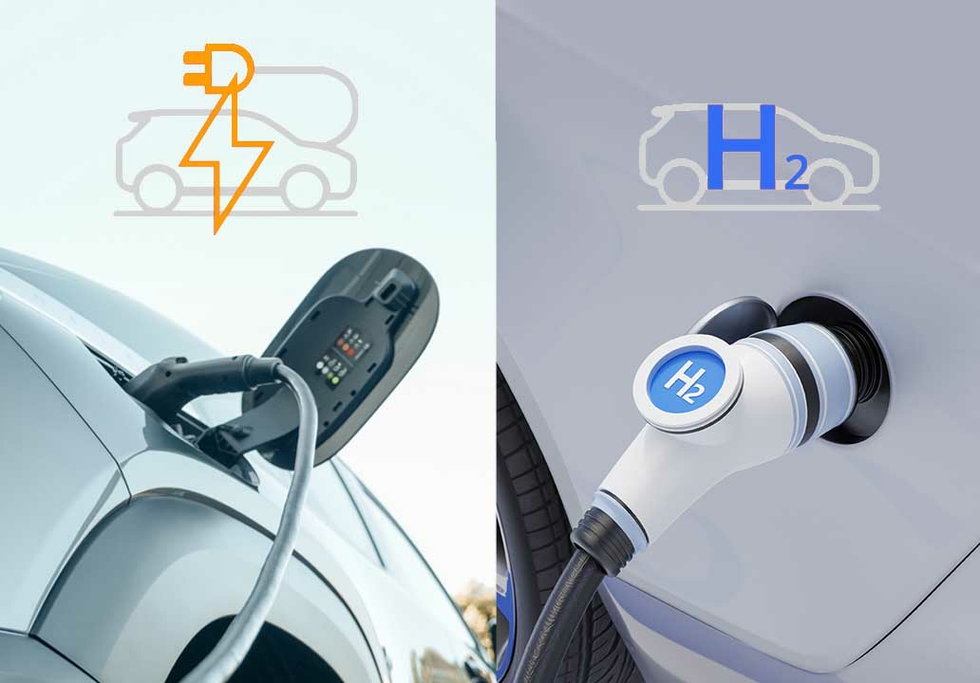
On a day-to-day level, with only 15 hydrogen filling stations, compared with 43,626 electric vehicle charging points, across the United Kingdom, hydrogen is not a practical option for many of us looking to use our vehicles regularly for work and leisure. Most automakers have shifted their focus towards electric vehicles, with only Toyota and Hyundai producing hydrogen fuel cells for the UK. Both Toyota and Hyundai’s models are expensive to buy, with the Hyundai Nexo priced at around £70,000 and the Toyota Mirai at £50,000. Furthermore, once you’ve bought the car, the running costs are currently higher than for a conventional or electric car. In the UK, hydrogen fuel ranges from £10 to £15 per kg, meaning that it will cost around £11.40 to cover 100km, compared with £7.48 for petrol, £6.76 for diesel, and just £2.79 to charge an electric vehicle to cover this distance.
So why talk about hydrogen fuel cells at all?
There is extensive debate over whether there is enough lithium and cobalt locked inside igneous rock formations and saltwater brine to meet the demand of an electric car revolution. Hannah Ritchie, a data scientist at Oxford University, examined this question in detail. Although the earth hosts approximately 88 million tonnes of lithium, which is enough to supply electric vehicles for decades into the future, only 25% of this is economically viable to mine. Ritchie found that these reserves would be enough to power 2.8 billion EVs, compared with the 1.4 billion cars on the road at present. Likely to increase with innovations and developments in mining and battery technology. Nevertheless, Ritchie’s estimations also showed that an electrified economy by 2030 would require between 250,000 to 450,000 tonnes of lithium, compared to the 105 tonnes of lithium produced worldwide in 2021. This is the major obstacle of the electric vehicle revolution:
How do we increase our lithium production by 250,000%, and fast?
To understand electric vehicles further, read our comprehensive guide to electrifying the future.
Sophie Ben-Tovim
19/06/2023


